Back to School Timetable in Flat Style: Versatile Design for Modern Planning
If you have ever tried to build a schedule that actually works—whether for a classroom, a content calendar, or a personal routine—you know that clarity matters just as much as content. A Back to School Timetable in Flat Style brings together clean visual language and practical layout thinking. It is not just about listing classes or tasks. It is about creating a structure that people actually want to look at and use.
Flat design has earned its place in modern digital and print creation. It strips away unnecessary ornamentation and focuses on function. When applied to a timetable, that approach means immediate readability, easy customization, and broad compatibility across tools like Adobe Photoshop, Illustrator, and EPS formats. Whether you are a teacher organizing a semester, a freelancer mapping out project deadlines, or a marketer planning a campaign launch, this style offers a practical foundation.
What Makes a Flat Style Timetable Stand Out
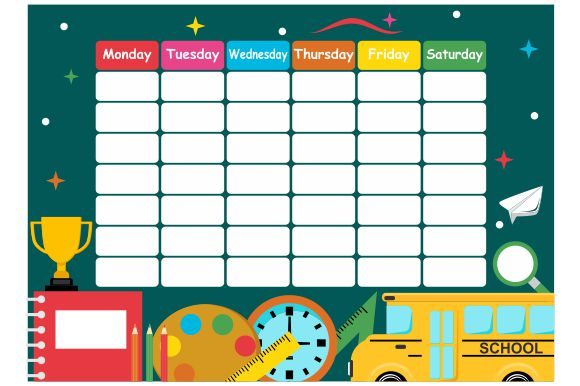
The core strength of a flat style timetable lies in its simplicity. Without gradients, drop shadows, or complex textures, the information itself becomes the hero. Colors are deliberate and purposeful. In the Back to School Timetable in Flat Style, the RGB color model ensures that what you see on screen matches across devices—monitors, tablets, phones, and presentations.
Scalability is another major factor. Because the design relies on vector elements, you can resize the timetable from a smartphone wallpaper to a poster without losing sharpness. This makes it useful for both digital and printed contexts. Teachers might print it for a classroom wall, while a blogger could embed it in a planning resource for their audience.
Easy color editing is a feature worth highlighting. When you work with PSD, AI, or EPS files, changing the palette to match a brand, school colors, or a personal theme takes minutes. You are not locked into someone else's aesthetic. That flexibility matters when you need the timetable to feel like your own.
Practical Applications Across Different Environments
A well-designed timetable serves more than just students. Let us explore where this flat style resource fits into real workflows.
For educators and school administrators, the timetable becomes a communication tool. You can place it in syllabi, on bulletin boards, or in digital newsletters. The flat style keeps it legible from a distance and on small screens. Parents appreciate a clean schedule they can pin to the fridge without visual clutter.
Freelancers and entrepreneurs often juggle multiple projects. Using a timetable layout for weekly planning helps visualize time blocks. The flat aesthetic reduces cognitive load. You scan the grid and see your commitments without fighting decorative elements. You can also rebrand the timetable for client deliverables—showing a proposed schedule during a kickoff meeting, for example.
Marketers and content creators can adapt the timetable for editorial calendars or social media posting schedules. Because the files are fully editable in Illustrator or Photoshop, you can replace subject labels with campaign phases, content topics, or publishing dates. The flat style aligns well with modern brand identities that favor clean, approachable visuals.
Publishers and bloggers might offer the timetable as a free resource for their audience. Parents looking for back-to-school organization tools will download and use it. When you provide a resource that is both attractive and functional, you build trust with your readers. The fact that it includes multiple file formats means your audience can open and edit it regardless of their software preference.
Key File Formats and What They Mean for You
When a product includes PSD, AI, and EPS files, it is designed for versatility. Here is what each format brings to the table:
- PSD (Adobe Photoshop) allows pixel-level editing. If you want to add raster textures, photo backgrounds, or detailed effects, this is your format.
- AI (Adobe Illustrator) keeps everything vector-based. You can scale the timetable infinitely, change colors globally, and export for print or web with precision.
- EPS (Adobe Illustrator 10 version) offers backward compatibility. Even if you are using an older version of Illustrator, you can open and edit the file without conversion issues.
Having all three means you are not limited by your software version or your comfort level with vector versus raster editing. If you prefer working in Photoshop for layout and then tweaking vector elements in Illustrator, you can do that. The Back to School Timetable in Flat Style is built to accommodate different workflows.
Realistic Use Cases and Recommendations
Let us walk through a few scenarios where this timetable genuinely solves a problem.
Scenario one: A middle school teacher needs to create a weekly schedule for their classroom. They have access to Illustrator and want something that looks professional but does not require hours of design time. They open the AI file, change the color palette to match their school colors, add their class names, and print. Total time: under fifteen minutes. The flat style ensures that students can read the schedule from across the room.
Scenario two: A freelance graphic designer is pitching a branding package to a local tutoring center. Part of the proposal includes a sample timetable for the center to use with students. The designer customizes the flat style timetable, changes the typography to match the brand, and presents it as a deliverable. The client sees immediate value because the resource is practical and visually consistent with the brand identity.
Scenario three: A parent blogger creates a back-to-school resource roundup for their audience. They include the editable timetable as a free download. Their readers appreciate that it works in Photoshop and Illustrator, and that they can change colors to fit their child's preferences. The blogger gains engagement and shares, while the audience gets a useful tool.
Recommendation: When you use the timetable, start by duplicating the original file. Work on a copy so you always have a clean template. Experiment with color variations before committing to a final version. Because the design uses flat style, even a simple two-color palette can look polished and intentional.
Why Flat Style Works for Timetables
Flat design is not a trend that fades. It is rooted in principles of usability and accessibility. For a timetable, the most important thing is that users can find the information they need quickly. Decorative excess gets in the way. The Back to School Timetable in Flat Style embraces that philosophy.
Color in flat design serves as a functional tool, not just decoration. You can assign different colors to different subjects, projects, or priorities. Because the RGB color space is used, the hues remain consistent across screens. If you later decide to print, you can convert to CMYK easily within your editing software.
Another advantage is file size. Vector-based flat designs tend to be smaller than their complex counterparts. This makes distribution easier. You can email the file, upload it to a cloud service, or offer it as a download without worrying about large file sizes that frustrate users.
Practical Considerations When Working with the Files
Before you jump into editing, take a few steps to ensure a smooth experience.
- Check your software version. While the EPS file is compatible with older versions of Illustrator, the AI and PSD files may require more recent releases. If you are on an older version, start with the EPS file.
- Understand layer organization. Well-organized files save time. Look for labeled layers for colors, text, and background elements before you start making changes.
- Make global color changes early. If you plan to rebrand the timetable, adjust the color palette first. Then edit the text. This workflow prevents you from having to redo work later.
- Consider your output medium. If the timetable will be viewed primarily on screens, keep it in RGB. If printing is the main use, convert to CMYK and adjust color values for accuracy.
- Test readability. After you edit the timetable, step back and check if the information hierarchy still works. The flat style relies on contrast and spacing. Make sure your color choices do not reduce legibility.
If you run into any issues while customizing the timetable, support is available. The product listing indicates that you can contact the seller for help. Do not hesitate to reach out if a layer is hidden or a color does not behave as expected. Good design resources come with support for a reason.
Observations on Usability and Efficiency
Over time, you will notice that a well-structured timetable reduces friction in your daily planning. When you do not have to fight with the layout, you spend more time on the actual content. The Back to School Timetable in Flat Style removes that friction.
For entrepreneurs and business owners, this translates to faster onboarding of new processes. If you hire an assistant or a team member, you can share the editable timetable as part of your workflow documentation. They can adapt it to their own needs without needing design training.
For educators, the timetable supports better communication with parents and students. A clear, colorful schedule posted in a classroom or on a learning management system reduces confusion. Students know where to be and when, and parents can reinforce routines at home.
For creators and hobbyists, the timetable offers a starting point for other projects. Use it as a layout template for habit tracking, reading challenges, or event planning. The flat style adapts easily to different contexts because it does not carry thematic baggage.
Final Thoughts on Choosing a Flat Style Timetable
When you evaluate a timetable resource, look beyond the visual appeal. Consider how it fits into your workflow, whether the file formats work with your tools, and how much time you will save compared to building from scratch. The Back to School Timetable in Flat Style delivers on all these fronts. It is practical, customizable, and built for real use.
Whether you are a teacher preparing for the semester, a marketer organizing a campaign, or a parent helping a child build structure, this timetable gives you a solid foundation. The flat style ensures clarity. The editable files give you control. And the support ensures you are never stuck.
Spend your energy on what matters—populating the schedule with meaningful content. The design work is already done.