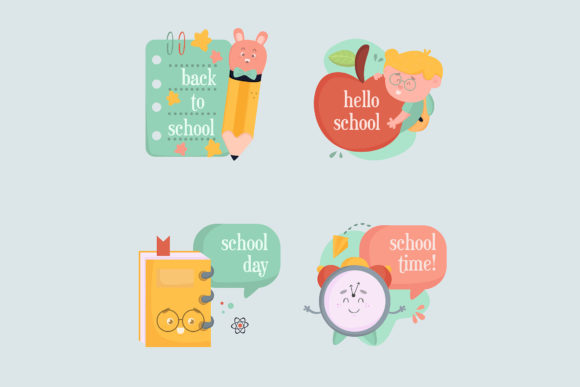
Back to School Badges Collection: Practical Uses for Creators, Marketers, and Small Business Owners
If you have ever scrambled to create visuals for a seasonal campaign, a classroom project, or a social media push, you already know how much time those small graphics can eat up. A Back to School Badges Collection built around flat design illustration in EPS 10 format is one of those resources that looks simple on the surface but solves a surprisingly wide range of real problems. Whether you are a blogger preparing content for August, a small business owner refreshing your storefront, or a freelancer juggling multiple client projects, having a set of ready-to-use badges can save hours and help you maintain consistent quality across different platforms.
What Exactly Is This Collection and Why Does the Format Matter?
At its core, a Back to School Badges Collection is a set of graphic elements designed around the themes, symbols, and colors commonly tied to the back-to-school season. Think graduation caps, pencils, apples, books, chalkboards, rulers, and school buses. The flat design style means the illustrations use solid colors, minimal shading, and clean shapes, which makes them easy to scale, recolor, and integrate into various layouts. The EPS 10 format is particularly relevant here because it is a vector standard that works across almost all professional design software, including Adobe Illustrator, CorelDRAW, Affinity Designer, and even some free alternatives like Inkscape. Vectors remain crisp at any size, so you can use the same badge on a business card, a website header, a poster, or a large banner without worrying about pixelation.
For someone who is not a full-time designer, that flexibility matters. You are not locked into one specific use case. You can open the file, tweak a color to match your brand palette, resize the element, and export it as a PNG or JPG for quick use. For experienced designers, the collection becomes a time-saving starting point rather than a final product. You can deconstruct the badges, mix elements from different ones, and build entirely new compositions without starting from scratch.
Where and When People Actually Reach for These Badges
The back-to-school season runs roughly from mid-July through September in most regions, but the reality is that badges of this style get used year-round. Teachers and educators might use them for classroom decorations, reward charts, or subject labels at the start of a new term. Bloggers and content creators often plan their editorial calendars weeks in advance, so having a badge collection ready means they can produce posts, social media graphics, and email headers well ahead of the rush. Small business owners who run retail stores, Etsy shops, or service-based businesses frequently run promotions tied to the academic calendar. A tutoring center, for instance, might use badges to highlight special offers for new students or to create signage for an open house event.
One common scenario is a parent who also runs a side business. You might need to create a flyer for a local parent-teacher association event, design a social media post for your small shop, and help your child with a school project, all in the same week. Instead of juggling multiple design styles or starting from scratch each time, a single collection gives you a cohesive visual language that works across those different contexts. The flat design aesthetic is neutral enough to feel modern and clean but specific enough to convey the back-to-school theme without looking generic.
Bloggers and Content Creators
If you run a blog about parenting, education, organization, or even lifestyle content, seasonal graphics help your posts stand out in crowded feeds. A badge featuring a stack of books with the words "Back to School Tips" can serve as a Pinterest pin image, a featured image for a blog post, or a header for a newsletter. Because the collection comes as EPS 10 vectors, you can export the same badge at different aspect ratios without losing quality. You might use a square version for Instagram, a horizontal version for your blog hero image, and a smaller circular crop for your email avatar. Having a consistent visual theme across those channels builds recognition with your audience.
Another practical angle is the ability to create printable resources for your readers. A badge collection can become the starting point for a free download, such as a weekly planner for students, a checklist for school supplies, or a set of motivational cards. Those freebies drive email sign-ups and social shares, and they also position you as someone who delivers practical value, not just articles.
Freelancers and Creative Professionals
If you are a freelance graphic designer, illustrator, or social media manager, you are constantly balancing speed and quality. A Back to School Badges Collection can act as a base layer for client projects. Let us say a client runs an after-school program and needs a series of social media posts for the next three months. Instead of designing each post individually, you can build a template system around the badges. Change the background color, swap out the badge, update the text, and you have a fresh post in minutes. The client gets a cohesive look across their entire campaign, and you free up time to focus on the strategic parts of the project.
For illustrators and designers who sell their own assets, understanding what makes a collection like this valuable helps you create better products for your own audience. The EPS 10 format is a standard that experienced buyers look for, and flat design remains popular because it reproduces well on screens and in print. If you are considering launching your own badge set, pay attention to the variety of themes included. A collection that only has five badges is less useful than one with fifteen to twenty, especially if those badges cover different subjects, moods, and color schemes.
Small Business Owners and Entrepreneurs
Retail stores, both physical and online, can use badges for window displays, product tags, promotional banners, and social media posts. A clothing boutique might run a "Back to School Wardrobe" sale and use badges to highlight discounts on specific items. A local bookstore could place badges on tables that feature books for different grade levels. Even service-based businesses like music schools, sports leagues, or tutoring centers benefit from having a visual shorthand that signals the seasonal nature of their offerings.
One thing to keep in mind is brand consistency. If you already have a distinct brand color palette, look for a collection that uses neutral base colors or offers editable files. EPS 10 files usually allow you to change the fill color of each shape, so you can adapt the badges to match your brand without losing the original design quality. This is much harder to do with raster images or low-resolution graphics.
Educators and School Staff
Teachers often spend their own money and time on classroom materials. A badge collection might seem like a small resource, but it can be reused in many ways throughout the year. Use badges to label different areas of the classroom, create a visual schedule, design a bulletin board display, or make reward cards for students. Because the collection is digital, you can print as many copies as you need, at any size, without worrying about running out of stickers or buying new packs each year. The flat design style also prints well on standard home or school printers, which is not always the case with highly detailed illustrations.
Publishers and Content Teams
If you work in educational publishing, curriculum development, or any field that produces learning materials, badges can serve as icons, section dividers, or visual cues in worksheets, e-books, and presentations. They add a layer of polish that makes your materials look professionally designed without requiring a dedicated illustrator for every project. For teams that produce a high volume of content, having a shared asset library with a consistent style is a practical way to maintain quality across different authors and designers.
What to Consider Before Choosing or Using a Badge Collection
Not all collections are created equal, and the right one for your project depends on how you intend to use it. Start by checking the file format. EPS 10 is ideal because it is widely supported, but make sure your software can open it. Some free programs handle EPS with limitations, so you may need a dedicated vector editor for full editing capabilities. If you do not own professional design software, look for collections that also include high-resolution PNG files with transparent backgrounds. That way, you can use the badges immediately without needing to learn vector editing.
Consider the number and variety of badges in the set. A collection that includes only generic school icons might not cover your specific needs. Look for sets that include different shapes, such as circular badges, rectangular ribbons, and shield-style emblems. This variety gives you more layout options when designing. Also pay attention to the color palette. Some collections use a cohesive set of colors that work well together, while others might include too many clashing hues. If you plan to use the badges across multiple projects, a more restrained palette is easier to adapt.
Another practical consideration is the licensing. If you are using the badges for commercial purposes, such as in products you sell or in marketing materials for a business, make sure the license allows that. Some collections are restricted to personal use only. Read the terms carefully, even if the product page says "commercial use." If you are a freelancer creating work for clients, you need a license that covers that kind of usage.
Finally, think about scalability and customization. The best collections are those that allow you to edit individual elements, not just the whole badge. For example, you might want to change the text on a badge from "Welcome Back" to "New Year, New Goals." If the text is embedded as a vector shape rather than a raster image, you can edit it directly. Some collections include editable text layers, while others treat the entire badge as a single locked object. Check the product description or previews before you buy or download.
Connecting Features to Real Outcomes
It is easy to list features like "scalable vectors" or "flat design style," but what those features actually mean in practice is the difference between a frustrating experience and a smooth one. Scalable vectors means you do not need to search for a larger version of the same badge when you suddenly need to print a poster instead of a web graphic. Flat design means the badges load quickly on websites, look consistent across different screen types, and remain readable even when printed at small sizes. EPS 10 compatibility means you can hand the file off to a colleague, a client, or a printer without worrying about format issues.
A collection like this is not going to transform your business overnight, but it can remove a recurring friction point. Every time you save twenty minutes on a graphic, that time accumulates. Over a month or a season, those saved minutes turn into hours that you can redirect toward strategy, content creation, or simply taking a break. For small business owners and freelancers, that is a tangible benefit.
Final Thoughts on Making the Most of a Badge Collection
The best way to approach a resource like this is to treat it as a toolkit, not a finished product. Open the file, explore the layers, experiment with colors, and combine badges in ways the original designer might not have imagined. The more comfortable you become with editing vectors, the more value you will extract from a single collection. If you are new to vector design, start with small edits like changing a single color or rotating a badge. As you build confidence, you will find yourself using those badges in unexpected places, from presentation slides to product packaging.
The back-to-school theme is seasonal, but the badges themselves are versatile enough to carry into other contexts. An apple badge works for a healthy eating campaign. A book badge can represent knowledge sharing in a corporate newsletter. A pencil badge might appear in a creative workshop flyer. Once you own the collection, you decide the boundaries of its use. That flexibility, combined with the practical advantages of flat design and vector format, is what makes a Back to School Badges Collection a genuinely useful asset for anyone who creates visual content regularly.